
Manual vs Machine-Sliced Turmeric is a debatable topic among post-harvesting product of a turmeric. A buyer in Surabaya once laid two bags of dried turmeric slices side by side on an inspection table. Both were labeled Grade A, both came from Central Java, both were harvested within the same two weeks.
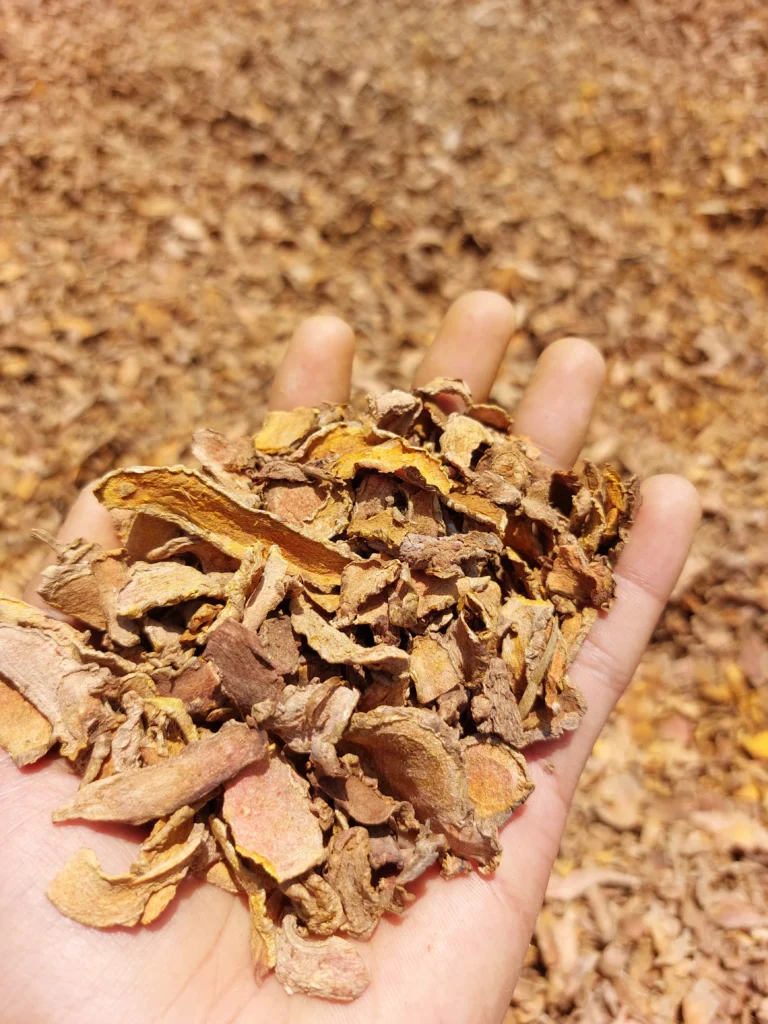
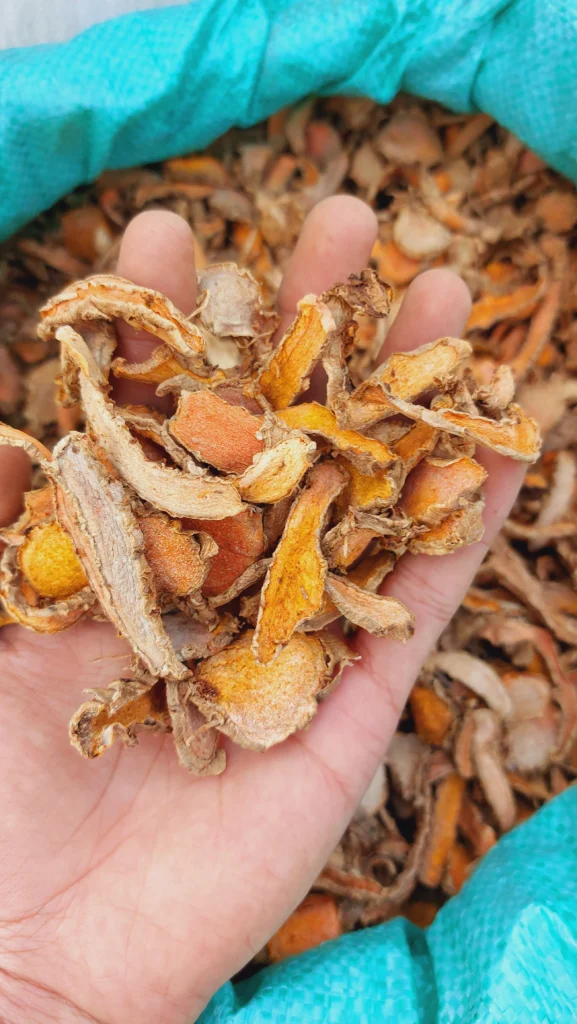
Yet the slices looked like they belonged to different shipments entirely. One batch was thin, even, and glowed a consistent orange. The other had slices ranging from paper-thin to almost a centimeter thick, some curled at the edges, a few noticeably darker than the rest.
The supplier’s answer was simple. One batch was sliced by hand. The other came off a slicing machine.
That single difference in method explains far more than the visual gap on an inspection table. It touches drying time, moisture control, microbial risk, and even how efficiently the turmeric performs once it reaches an extraction plant.
For a buyer sourcing raw or semi-processed turmeric from Indonesia, understanding what happens at the slicing stage is one of the more overlooked parts of quality due diligence.
Why turmeric fights back against machines
A mechanical slicer, whether a simple rotary blade unit or a more advanced shearing-type machine, is built to do one thing well: cut repeatedly, at high volume.
Machines built for slicing agricultural products, potato chips, carrots, onions, work well because those crops are fairly round and uniform in diameter. A rotary or reciprocating blade can cut through them at a steady thickness because the shape barely changes from one piece to the next.
Turmeric rhizomes don’t cooperate that way. They grow as clusters of curved, tapering fingers, thick at one end and narrow at the other, often bent at odd angles.
A blade set to cut at a fixed height slices cleanly through the thick middle of one finger, catches the narrow tip of the next at an angle, and shears clean through a curve on a third. The result is exactly what one Indonesian supplier described to a curious buyer: some slices come out fine, others come out crushed or split, and thickness ends up all over the place.
This isn’t a one-off complaint. Research on slicing machines built for other irregular, fibrous root crops describes the same core problem in almost identical terms. A recent engineering study on slicing astragalus root, a similarly gnarled root crop used in traditional medicine, was developed specifically to address what the researchers called fragmentation, uneven thickness, and high loss rates when slicing irregular root materials (Wang, Sun, & Simionescu, 2025). That is the exact defect pattern showing up in turmeric.
What the numbers say about machine slicing
Performance trials on a purpose-built turmeric rhizome slicer found material loss, meaning rhizome turned to unusable fragments or fines rather than clean slices, ranging from about 4% up to 7.6%, depending on how the machine’s rotor speed and feed rate were set (Devarshi et al., 2023).
Push the machine for higher throughput and the loss climbs. Slow it down and calibrate carefully, and loss drops, but so does capacity.
That trade-off is the heart of the problem. A machine can be tuned to slice turmeric reasonably well, but only with careful, continuous calibration, well-maintained blades, and an operator watching for drift as the rhizome batch changes in size and moisture.
Many small and mid-scale processing operations in Indonesia don’t have the equipment or the technical oversight to hold that calibration consistently, batch after batch. Without it, the machine’s speed advantage comes at the cost of broken pieces, uneven thickness, and a lower-grade appearance that buyers notice immediately.
What manual slicing gets right
A worker slicing turmeric by hand adjusts instantly to what’s in front of them. A thick finger gets angled differently than a thin one.
A curved piece gets turned as it’s cut. Damaged or rotten spots get caught and set aside before they ever reach the drying trays, something no machine sorts out on its own.
Just like an atelier, handcrafted like its an art.
The result is slices that are far more consistent in thickness across a batch, and far less broken material. It’s slower, and it depends on the skill of the person doing the cutting, but for a crop shaped like turmeric, that hands-on adaptability is exactly what a rigid blade setup struggles to match.
Why consistency at the slicing stage still matters downstream
Slicing turmeric, done properly, shortens drying time considerably and helps preserve the compounds buyers are paying for.
One study comparing sliced turmeric against whole-rhizome curing found drying time dropped to about five days for sliced material, versus twelve days for steam-cured whole rhizomes, with sliced samples also retaining more essential oil, oleoresin, and curcumin (Rakhi, Jayashree, & Zachariah, 2019).
A related study found that the longer a rhizome sits before it’s fully processed and dried, the more those same compounds decline (Jayashree & Zachariah, 2016).
Those benefits depend on the slices actually being uniform. A batch with a wide spread of thicknesses, the kind a poorly calibrated machine tends to produce, dries unevenly.
Thin fragments finish first and risk over-drying or scorching at cut edges, while thicker chunks lag behind and stay damp longer, raising the risk of mold during storage or a long sea shipment. Manual slicing’s tighter thickness range avoids this mismatch far more reliably in everyday practice.
Where machines still make sense
None of this means mechanical slicing should be ruled out entirely. Operations running very large volumes, with well-maintained equipment, trained technicians, and the discipline to recalibrate regularly, can get consistent results from a machine, and at a scale manual cutting can’t match.
The Devarshi et al. (2023) trial itself found a well-tuned machine capable of clean, high-capacity output under the right settings. It is could be a machine that has reciprocal moves instead of radial moves.
The practical reality for most Indonesian turmeric processors, though, is that hitting and holding those ideal settings day after day is harder than it sounds. For that reason, manual slicing remains the more dependable choice for buyers who prioritize visual uniformity, low breakage, and predictable drying behavior over raw processing speed.
What to ask a supplier
A useful question for any buyer evaluating a turmeric supplier is simply how the slicing is done, by hand or by machine, and if it’s mechanical, what breakage or fines rate the supplier typically sees and how often blades and settings are checked.
Requesting a physical sample and looking for thickness consistency and clean, uncrushed edges tells a buyer more in thirty seconds than any spec sheet.
FAQ : Manual vs Machine-Sliced Turmeric
Is machine-sliced turmeric automatically lower quality?
Not automatically, but in practice it often is for smaller operations. The machine’s output quality depends heavily on calibration and maintenance discipline, which many mid-scale processors struggle to sustain consistently. A well-run manual line frequently outperforms a loosely managed mechanical one.
Why can’t turmeric be sliced as cleanly as potatoes or carrots by machine?
Those crops are relatively round and uniform in shape, which suits a fixed-height blade. Turmeric rhizomes are irregular, curved, and taper unevenly along their length, so a blade set at one height cuts inconsistently across different parts of the same piece.
How can a buyer check slicing quality before ordering?
Ask for a physical sample and inspect it for thickness consistency and the amount of broken or crushed material mixed in. A supplier confident in their process will usually welcome the scrutiny.
References
Devarshi, N., et al. (2023). Design and development of fresh turmeric rhizome slicer. The Pharma Innovation Journal.
Jayashree, E., & Zachariah, T. J. (2016). Processing of turmeric (Curcuma longa) by different curing methods and its effect on quality. The Indian Journal of Agricultural Sciences, 86(5).
Rakhi, R., Jayashree, E., & Zachariah, T. J. (2019). Comparison of quality of dry turmeric (Curcuma longa) produced by slicing and other curing methods. Journal of Spices and Aromatic Crops.
Wang, Z., Sun, W., & Simionescu, P. A. (2025). Design and optimization of an astragalus slicing machine using computer simulations and design of experiments. Industrial Crops and Products.